When do you play your best chess?
Your strength is not a fixed number. It rises and falls with the time of day, the day of the week, and how long you have been playing. Knowing your pattern is free rating.
Two players with the same rating can get very different results from the same amount of play, and often the difference has nothing to do with chess knowledge. It is when and how they play. Your results are not uniform across the day or across a session, and the swings are bigger than most people expect. The good news is that this is one of the easiest edges to claim, because it costs you nothing to play at your best times and stop at your worst.
The session-length trap
The most common and most expensive pattern is the decline over a long session. You sit down sharp, win a couple, and then keep going. By the tenth game you are tired, playing on autopilot, and your win rate has quietly fallen off a cliff. The chart below is a very typical shape.
The lesson is blunt. Your best chess is usually in the first handful of games. If you know your win rate collapses after, say, six games, then the disciplined move is to set that as your session cap and walk away while you are still ahead. Almost every player has a session length past which they are net negative, and almost nobody knows their own number until they look.
Time of day and day of week
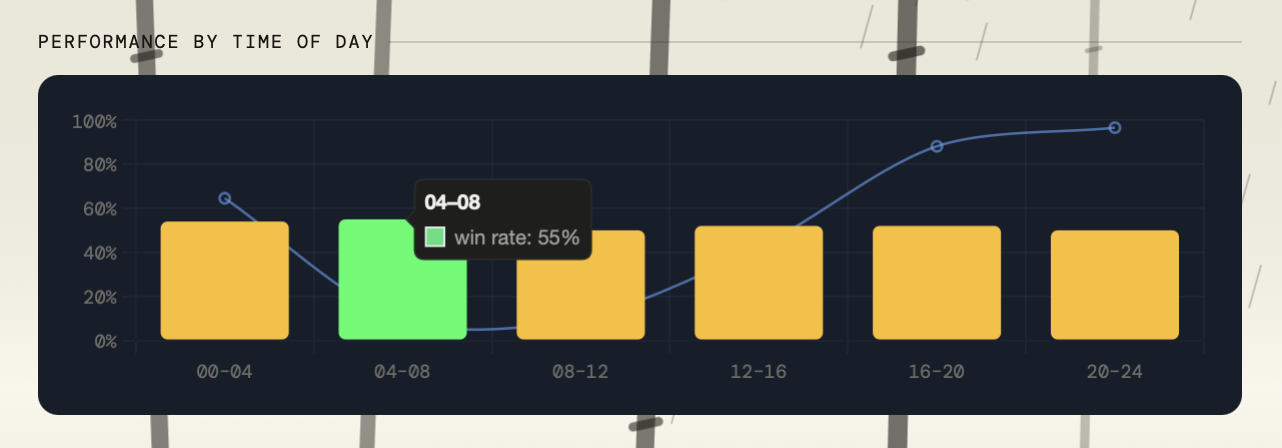
Beyond session length, most players have a clear best window in the day. Maybe you are sharp in the morning and loose late at night, or the reverse. The same is true across the week, where a relaxed weekend afternoon can produce very different chess from a drained weekday evening. None of this is guesswork once you have enough games logged, because the pattern is right there in your results. The only reason players miss it is that no single game reveals it. You need the aggregate.
The tilt multiplier
Session length and time of day both interact with tilt. A loss late in a long evening session hits harder than the same loss in your first game of the day, because you have less focus left to recover with. This is why the last games of a bad session tend to be the worst games of all. Recognising that you are in the danger zone, tired, a bit frustrated, and several games deep, is worth more than any tactic, because it tells you to stop.
Finding your best window in Statmate
The Insights tab turns this from a vague feeling into hard numbers. It breaks your win rate down by time of day, so your sharp and flat hours are obvious at a glance.
Its session analysis goes further, showing your win rate by game number within a session and by total session length, which is exactly the data you need to find your personal “stop” point.
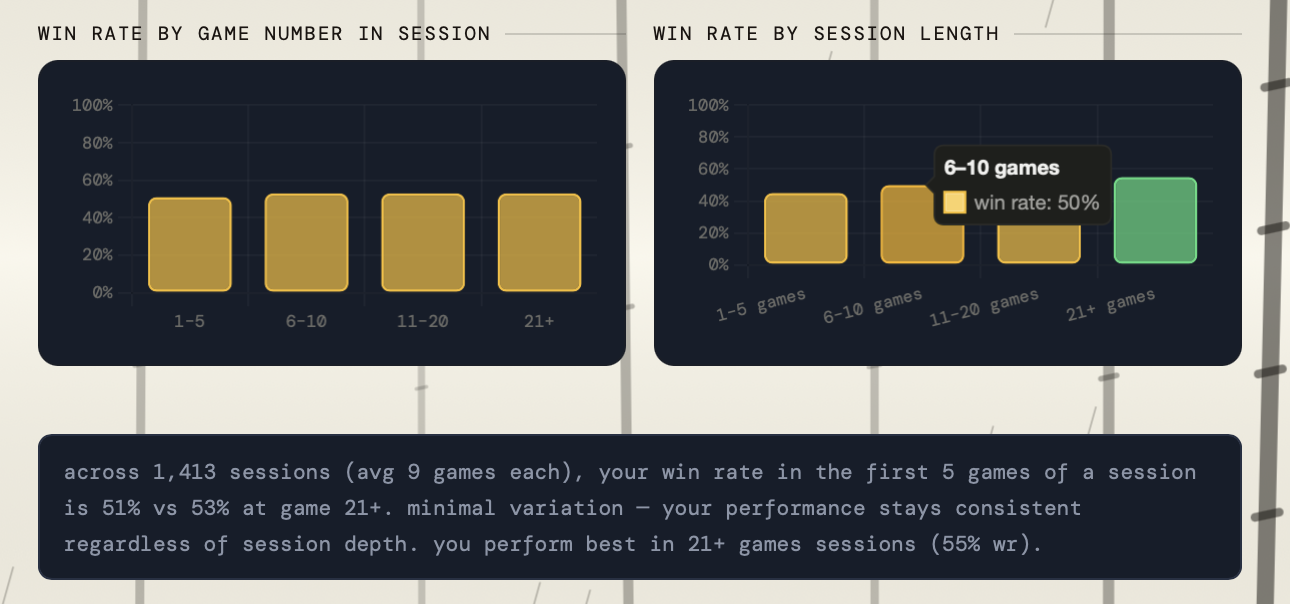
Put those together and you get a simple, personal rule, something like “I play my best on weekend mornings and should quit after five games,” and following it is pure rating for zero extra study.