Brilliant, Great, Blunder: what chess move classifications actually mean
Every move in a review gets a label. Here is what the engine is really measuring behind each one, and why a true Brilliant is rarer than most players think.
Open any game review, whether on Chess.com, Lichess, or in Statmate, and every single move you played is stamped with a label: Best Great Mistake Blunder, and if you are lucky, Brilliant. They feel intuitive, but they are not opinions. Each one comes from a precise engine measurement. Once you understand what that measurement is, reviewing your games gets far more useful, because you stop chasing labels and start seeing where games are actually won and lost.
It all comes down to one number
A chess engine does not think in words like “good” or “bad.” It thinks in centipawns, which are hundredths of a pawn. A position evaluated at +1.00 means the side to move is roughly one pawn ahead in material and position combined. Every move is judged by comparing the evaluation after your move to the evaluation of the best move the engine found. That gap is your centipawn loss. Play the top engine move and your loss is near zero. Hang a rook and your evaluation collapses, producing a large loss.
Raw centipawns are not the whole story, though, and this is the part most players miss. Modern reviews convert the evaluation into a win probability first. The reason is simple. A three pawn swing when you are already completely winning barely changes anything, because you were winning before and you are still winning after. That same three pawn swing near equality is catastrophic. So the label you get is weighted by how much your actual winning chances changed, not by the raw number. That is why dropping from +9 to +6 is still flagged Best, while a quiet slip from +0.3 to −0.5 can be a full Mistake.
The everyday tiers
Most of your moves fall on a simple ladder, ordered by how much of your winning chances a move gave away:
- Best or Excellent. You found the engine’s top move, or one just as strong.
- Good. A sound move with only a trivial imprecision.
- Inaccuracy. A small slip that hands a little something back.
- Mistake. A real error that noticeably worsens your position.
- Blunder. A serious error that can flip the game outright, such as hanging material or missing a forced tactic against you.
The clearest blunders are the ones that end the game on the spot. Here is the most common one in all of chess:
The special ones: Book, Great and Brilliant
Three labels do not sit on that ladder at all, because they measure something different.
Book is not an evaluation judgment. It simply means your move is still inside known opening theory, a move that has been played and catalogued countless times. It is neither praised nor punished. It is just still in the book.
Great is about criticality. A move earns Great when it is not merely the best move, but very nearly the only move that holds the position together, where almost every other reasonable looking option would have thrown the game away. It is the reward for finding the single narrow path when the position demanded exactness. A move can be Best in a calm position where three moves were all fine. It is only Great when the alternatives were a cliff edge.
Brilliant is the showpiece, and it has strict conditions. A Brilliant move is one that is both strong and a genuine sacrifice. You deliberately gave up material, whether a pawn, a piece, an exchange, or even your queen, and it is still the best move on the board, because the sacrifice wins by force or crashes through to a decisive attack. Engines single these out precisely because a human voluntarily giving up material that turns out to be correct is one of the hardest things to find over the board. Picture the diagram above in reverse. If White had to sacrifice the queen first, offering it up so that recapturing walks straight into that exact back-rank mate, that queen sacrifice would light up as Brilliant.
This is why brilliants are rare, and why earning one is a real compliment. A move only qualifies if the sacrifice is real, since a plain recapture never counts. It only qualifies if you were not already completely winning, because there is no bravery in sacrificing when you are up a queen. And it has to be genuinely the top move. Most flashy looking sacrifices fail one of those tests, which is exactly why the label means something on the rare occasion you do earn it.
Seeing your own classifications in Statmate
Statmate’s Game Analysis runs Stockfish 18, one of the strongest engines in the world, over any game in your history and labels every move with exactly these categories, calibrated to Chess.com’s standards so the numbers feel familiar. You get the classification for each move, an accuracy score for the whole game, and the strong moves you missed, all steppable on the board.
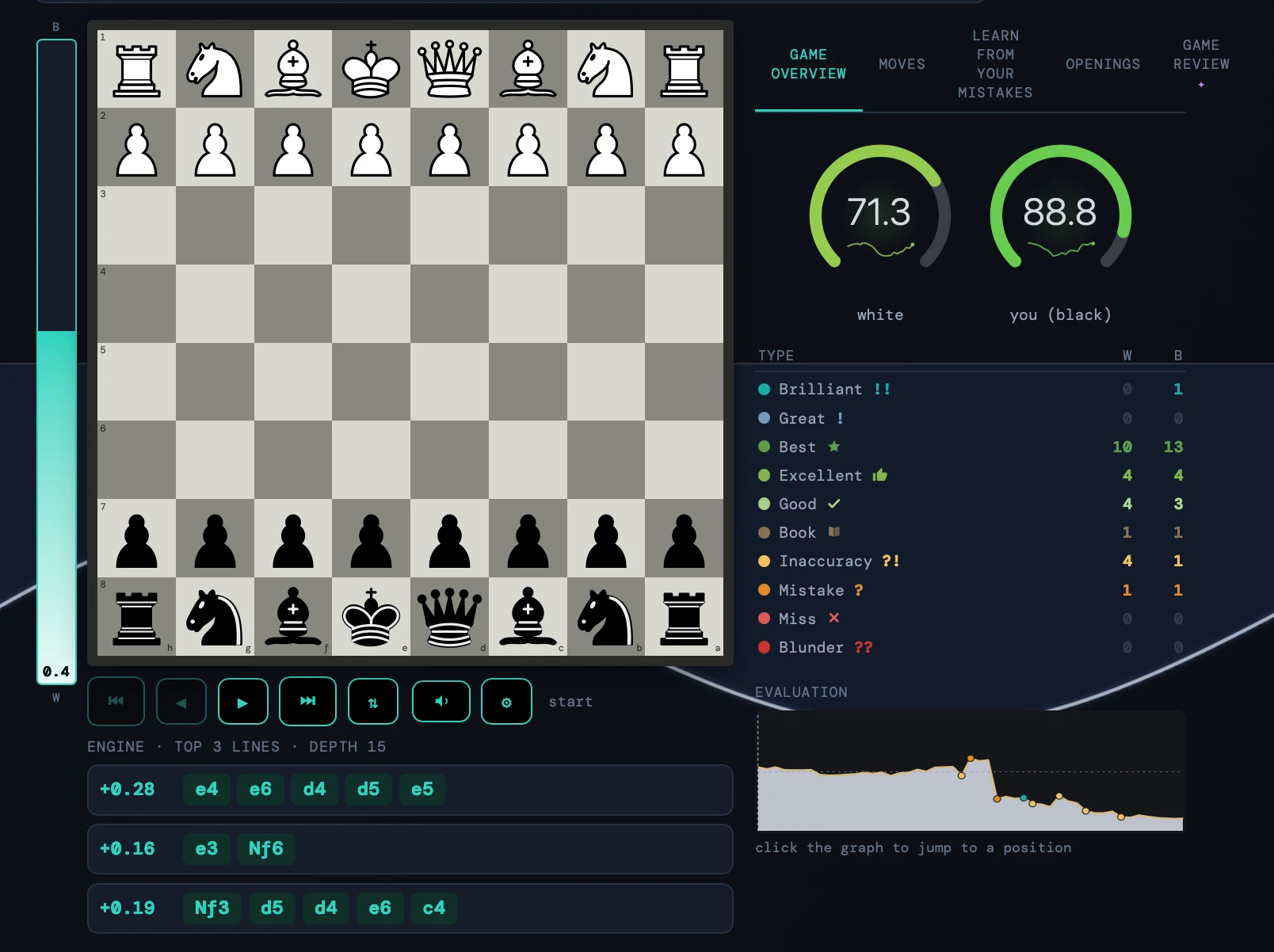
Free accounts get this through Stockfish 18 Lite running right in your browser. Premium runs the full engine on a dedicated server for deeper, faster reviews, and adds a written game review plus an estimated performance rating for the game.
Why any of this matters
Once you know what the labels are actually measuring, game review stops being about counting brilliants and starts being about one question. Where did my winning chances leak? A single Blunder in a losing game usually matters far more than five Best moves, and the moment in your review with the biggest swing is the one worth studying. That is where real rating comes from. Not from playing more brilliant moves, but from playing fewer blunders.