Finding your opening leaks: the lines quietly costing you rating
Some openings win you games. Others bleed rating so slowly you never notice. Here is how to tell the difference, and what to do about it.
Most players think about openings in terms of theory: which lines are “good,” which moves are “correct.” But the opening that is quietly costing you rating is rarely a theoretically bad one. It is usually an opening you play often and score badly in, without ever realising the pattern. That is an opening leak, and it hides in plain sight because any single loss feels like just another game.
What a leak actually looks like
Start with one number: your overall win rate across all your games. Call that your baseline. Now look at your win rate in each individual opening. An opening where you score close to your baseline is pulling its weight. An opening that sits well below your baseline, say ten percentage points or more under, over a meaningful number of games, is a leak. You are stepping into that position again and again and coming out behind more often than you should.
The phrase “over a meaningful number of games” is doing a lot of work there, and it is the single biggest mistake players make when reading their own opening stats.
Sample size is everything
A 25 percent win rate over four games tells you nothing. That is noise. Four games can go badly for reasons that have nothing to do with the opening, such as tilt, time trouble, or simply playing three strong opponents in a row. Before you treat a low win rate as a real signal, you want a reasonable sample, ideally fifteen to twenty games or more in that line. Below that, treat the number as a rumour, not a verdict. The openings worth acting on are the ones you play a lot and score poorly in, because that combination is where the rating is actually leaking.
A bad opening, or bad play in the opening?
This is the distinction that changes what you do next. When an opening scores badly for you, there are two very different causes. The first is that the opening genuinely does not suit you, giving you positions you do not enjoy or understand. The second, and far more common, is that the opening is perfectly fine but you do not know the typical middlegame plans that flow out of it. You reach a normal position and then drift, because you learned the moves and never learned the ideas.
That difference matters because the fix is different. If it is the plans, the answer is study, not surgery: look at how stronger players handle the resulting positions and learn the two or three standard ideas. If the opening genuinely gives you positions you hate no matter how much you study, then it is worth replacing with something that fits your style. Most leaks are the first kind pretending to be the second.
Colour changes the picture
One more thing worth checking: leaks are often specific to one colour. You might score well with the White side of a structure and badly with the Black side of the same one, or vice versa. Always look at your openings split by colour rather than lumped together, or a strong result on one side will mask a real problem on the other.
Spotting your leaks in the Opening Lab
Statmate’s Opening Lab does this comparison for you. It lists every opening you play with its game count, your win, loss and draw record, and a win rate, and you can sort the whole thing to bring your worst performing lines to the top. Because it shows the game count next to each win rate, the sample size problem takes care of itself: you can instantly ignore the lines you have only played a handful of times. Best and worst panels surface your strongest and weakest openings at a glance, a drill-down opens a full variation tree for any single line, and filters let you split everything by colour and time control.
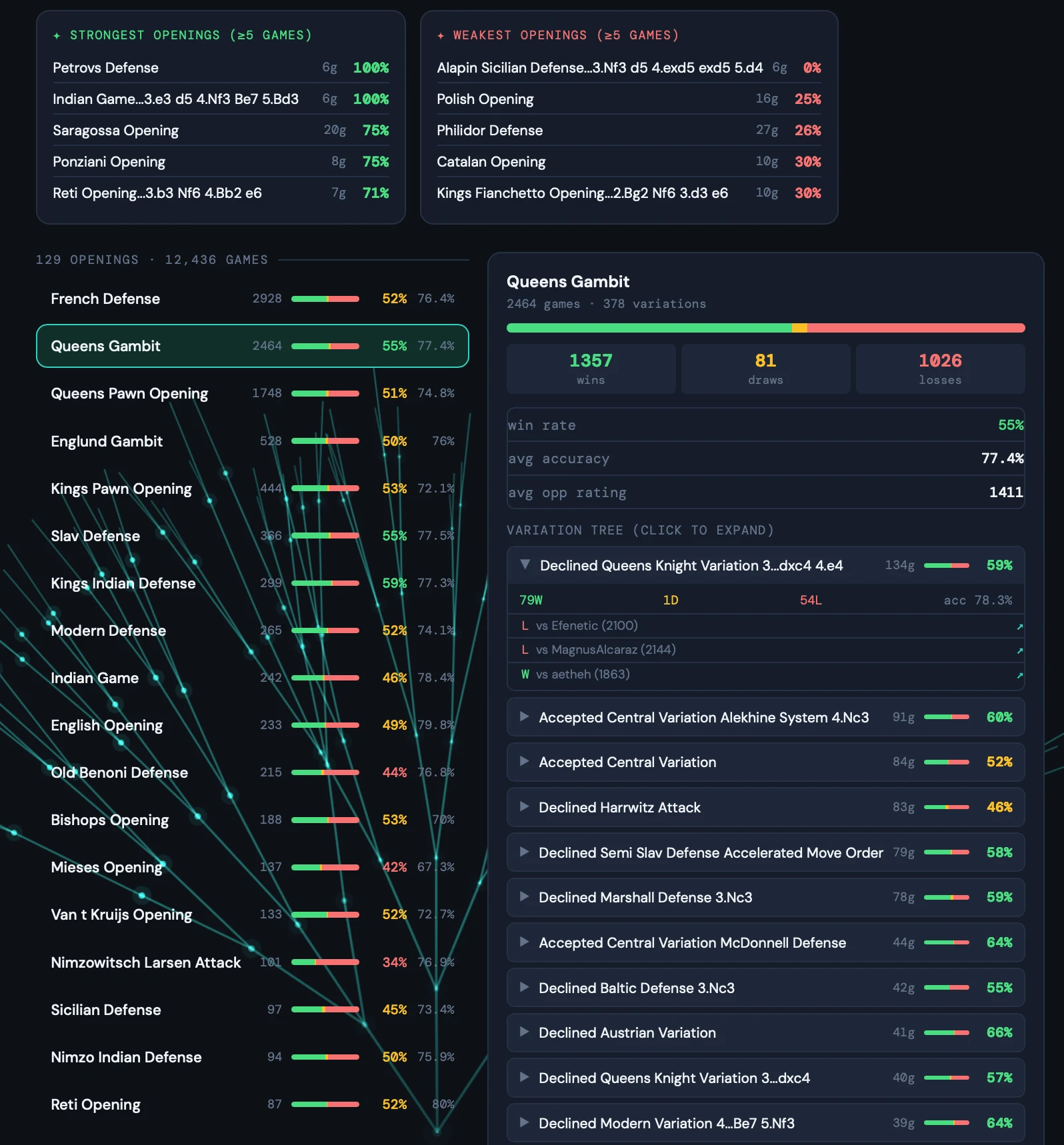
It even suggests openings worth learning or dropping based on your actual results, turning a wall of numbers into a short, concrete to-do list.
Turn it into one action
You do not need to overhaul your whole repertoire. Find your single biggest leak, the line you play most often and score worst in, and spend one study session on the plans behind it. Fixing one well-used leak moves your rating more than learning a fashionable new opening you will play twice, because the leak is costing you points every single week.